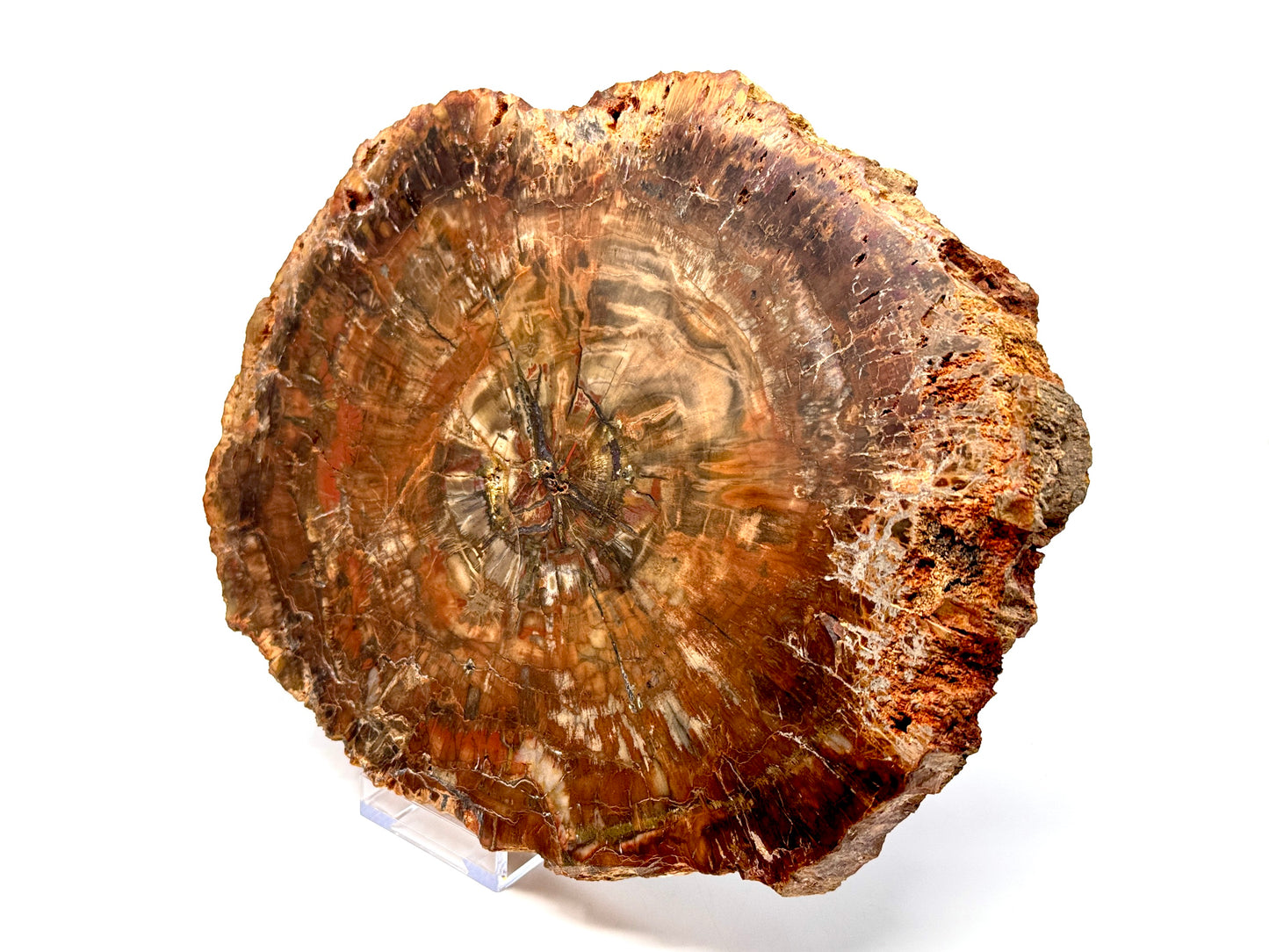
This large Fossil Wood Slice from Madagascar measures 27cm wide and is a beautiful display piece and a wonderful time capsule of trees from the Triassic period.
Origin and Geological Story
These slices come from ancient forests that grew roughly 220–240 million years ago during the Triassic period.
Back then, towering conifer trees—often related to Araucaria (monkey puzzle–type trees)—covered parts of what is now northwestern Madagascar.
After these trees died, they were rapidly buried by volcanic ash and river sediments. Over millions of years, groundwater rich in dissolved silica seeped through the buried wood. This triggered permineralization, a process where:
- Organic wood tissues decayed
- Minerals (mainly silica) replaced them cell by cell
- The original structure was preserved in stone
The result is fossil wood that is no longer wood at all—but quartz-based stone retaining every detail of the original tree.
Appearance and Structure
Large slices are cut cross-sections of fossilized logs, often polished to reveal their internal beauty.
Growth rings and texture
- Clearly visible tree rings, just like in modern wood
- Fine cellular detail sometimes preserved under magnification
- Occasional bark remnants or radial cracking
These features make each slice a literal “snapshot” of an ancient tree’s life.
Colour palette
Madagascar fossil wood is famous for its exceptional colour range, caused by trace minerals:
- Deep reds and rusty oranges (iron)
- Golden yellows and honey tones
- Browns, creams, and caramel bands
- Black streaks or smoky greys (manganese/carbon)
- Occasional pinks or subtle purples
These colours often form striped, banded, or swirling patterns, resembling abstract art.
Mineral Composition
Although it looks like wood, it is actually a mix of microcrystalline quartz varieties:
-
Chalcedony (dominant)
-
Jasper (opaque, richly coloured zones)
-
Agate (sometimes translucent banding)
- Quartz crystals in cavities
This is why it’s often called “agatized wood.”
They are typically:
- Cut from cylindrical fossil logs
- Flat on one or both sides
- Highly polished to a glass-like sheen
- Sometimes mounted on stands for display
Some massive slabs show entire trunk cross-sections, revealing the full growth-ring structure of a tree that lived over 200 million years old
Surface and finished
Madagascar is considered one of the world’s premier sources of petrified wood because:
- The deposits are extensive and well-preserved
- The mineral chemistry produces unusually vivid colours
- Large, intact logs are commonly found
- Erosion in arid landscapes continually exposes new material
The Healing Properties of Fossil Wood
Fossil wood—often called petrified wood—is sometimes associated with “healing properties,” but it’s important to be clear: these are spiritual or symbolic beliefs, not medically proven effects. There’s no scientific evidence that fossil wood can treat illnesses or change physical health outcomes. What it can do, for many people, is support reflection, mindfulness, and a sense of connection to nature.
Here’s how it’s commonly described in crystal and holistic traditions:
Grounding and Stability
Fossil wood is strongly linked with grounding energy—a feeling of being steady, anchored, and present.
Because it was once a living tree and is now stone, it’s often seen as a bridge between:
- Growth and stillness
- Life and deep time
- Change and endurance
People use it during meditation to feel more centred or to calm racing thoughts.
Patience and slow growth
Having formed over millions of years, fossil wood is associated with:
- Patience
- Long-term perspective
- Gradual transformation
- It’s often used symbolically when someone is working through slow processes—like career development, recovery, or personal change.
Emotional Balance
- Some traditions suggest it helps with:
- Reducing worry or overthinking
- Creating a sense of emotional stability
- Encouraging resilience during stressful periods
This likely comes from its visual and tactile qualities—smooth, solid, and earthy—which can be naturally soothing.
Connection and nature of past
Fossil wood is literally ancient life turned to stone, so it’s often used to foster:
- A deeper connection to Earth’s history
- Appreciation of natural cycles
- A feeling of continuity and rootedness
For some, holding a piece can be a reminder of how brief human stressors are compared to geological time.
Use in practices
People who value these symbolic properties often:
- Keep a polished slice or piece on a desk or in a living space
- Hold it during meditation or breathing exercises
- Use it as a visual anchor for mindfulness
- Place it in environments where they want a calmer atmosphere
A grounded perspective
If you’re drawn to fossil wood, it can absolutely have psychological or aesthetic value—it’s beautiful, ancient, and meaningful. But it shouldn’t replace evidence-based medical care or be relied on for physical healing.
A large Madagascar fossil wood slice feels like a fusion of:
-
Ancient biology (tree rings, growth patterns)
-
Geology (quartz, jasper, agate)
-
Natural art (colour bands and textures)
Each piece is completely unique—no two slices share the same pattern—making them prized both by collectors and as statement décor..